Meghnad Saha

Loading

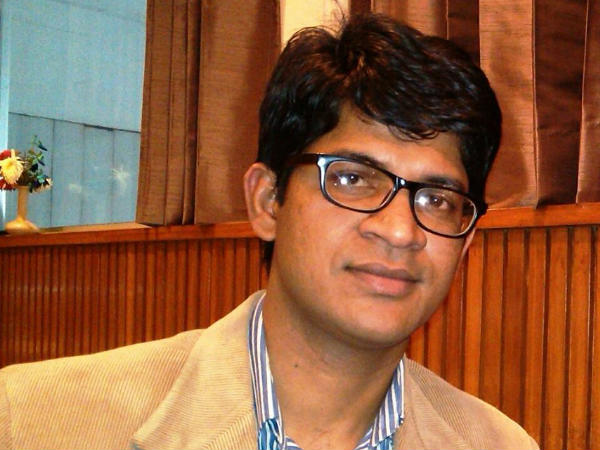
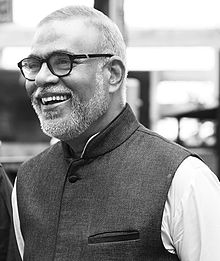
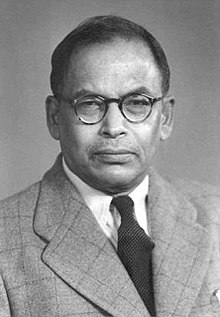
Meghnad Saha FRS (6 October 1893 – 16 February 1956) was an Indian astrophysicist who developed the Saha ionization equation, used to describe chemical and physical conditions in stars. His work allowed astronomers to accurately relate the spectral classes of stars to their actual temperatures. He was elected to the Parliament of India in 1952 from Calcutta.

Meghnad Saha was born in 1893 in a very poor family in Shaoratoli, a village near Dhaka-Bikrampur, in the former Bengal Presidency of British India (in present-day Village- Shaoratoli, Thana- Kaliakair, District- Gazipur, Bangladesh). Son of Jagannath Saha (a grocer) and Smt. Bhubneshwari Devi, Meghnad struggled to rise in life. During his early schooling he was forced to leave Dhaka Collegiate School because he participated in the Swadeshi movement. He earned his Indian School Certificate from Dhaka College. He was also a student at the Presidency College, Kolkata and Rajabazar Science College CU. As a student, Saha faced caste discrimination from his fellow upper-caste students. When Saha was at Eden Hindu Hostel, upper-caste students objected to him eating in the same dining hall because he was not from upper caste. He was also a professor at Allahabad University from 1923 to 1938, and thereafter a professor and Dean of the Faculty of Science at the University of Calcutta until his death in 1956. He became Fellow of the Royal Society in 1927. He was president of the 21st session of the Indian Science Congress in 1934.

For more details visit: https://en.wikipedia.org/wiki/Meghnad_Saha

Birsa Munda

Loading

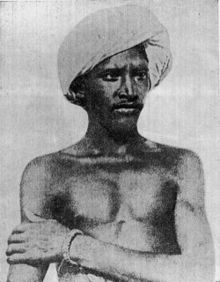
Birsa Munda pronunciation (help·info) (15 November 1875 – 9 June 1900) was an Indian tribal freedom fighter, and folk hero who belonged to the Munda tribe. He spearheaded a tribal religious millenarian movement that arose in the Bengal Presidency (now Jharkhand) in the late 19th century, during the British Raj, thereby making him an important figure in the history of the Indian independence movement. The revolt mainly concentrated in the Munda belt of Khunti, Tamar, Sarwada and Bandgaon.

Birsa received his education in Salga under the guidance of his teacher Jaipal Nag.Later, Birsa converted into a Christian to join the German Mission School but soon dropped out after finding out that Britishers were aiming to convert tribals to Christianity through education.

After dropping out of school, Birsa Munda created a faith called ‘Birsait’.

Members of the Munda community soon started joining the faith which in turn became a challenge for the British conversion activities.

The cause of the Munda revolt was the ‘unfair land grabbing practices by colonial and local authorities that demolished the tribal conventional land system’.

Birsa Munda is known for challenging the Christian missionaries and revolting against the conversion activities along with the Munda and Oraon communities.

His portrait hangs in the Indian Parliament Museum.

For more visit: https://en.wikipedia.org/wiki/Birsa_Munda

Scheduled Tribes of Lakshadweep

Loading

Throughout the Union territory: –

Inhabitants of the Laccadive, Minicoy and Aminidivi Islands who, and both of whose parents, were born in those islands.

‘Provided that the children who are born to inhabitants of Lakshadweep in any other place in the mainland of India shall be deemed to be inhabitants born in the islands if such children settle per-manently in the islands’.

Explanation: The term “settle permanently” shall have the same meaning as defined under Clause 3(I)(d) of the Lakshadweep Panchayat Regulation, 1994.

Sheduled Tribes of West Bengal

Loading

  1. Asur
  2. Baiga
  3. Bedia, Bediya
  4. Bhumij
  5. Bhutia, Sherpa, Toto, Dukpa, Kagatay, Tibetan, Yolmo
  6. Birhor
  7. Birjia
  8. Chakma
  9. Chero
  10. Chik Baraik
  11. Garo
  12. Gond
  13. Gorait
  14. Hajang
  15. Ho
  16. Karmali
  17. Kharwar
  18. Khond
  19. Kisan
  20. Kora
  21. Korwa
  22. Lepcha
  23. Lodha, Kheria, Kharia
  24. Lohara, Lohra.
  25. Magh
  26. Mahali
  27. Mahli
  28. Mal Pahariya
  29. Mech
  30. Mru
  31. Munda
  32. Nagesia
  33. Oraon
  34. Parhaiya
  35. Rabha
  36. Santal
  37. Sauria Paharia
  38. Savar
  39. Limbu (Subba)
  40. Tamang

Scheduled Tribes of Uttar Pradesh

Loading

  1. Bhotia
  2. Buksa
  3. Jaunsari
  4. Raji
  5. Tharu
  6. Gond, Dhuria, Nayak, Ojha, Pathari, Raj Gond (in the districts of Mehrajganj, Sidharth Nagar, Basti, Gorakhpur, Deoria, Mau,
    Azamgarh, Jonpur, Balia, Gazipur, Varanasi, Mirzapur and Sonbhadra)
  7. Kharwar, Khairwar (in the districts of Deoria, Balia, Ghazipur, Varanasi and Sonbhadra)
  8. Saharya (in the district of Lalitpur)
  9. Parahiya (in the district of Sonbhadra)
  10. Baiga (in the district of Sonbhadra)
  11. Pankha, Panika (in the districts of Sonbhadra and Mirzapur)
  12. Agariya (in the district of Sonbhadra)
  13. Patari (in the district of Sonbhadra)
  14. Chero (in the districts of Sonbhadra and Varanasi)
  15. Bhuiya, Bhuinya (in the district of Sonbhadra)

Scheduled Tribes of Tripura

Loading

  1. Bhil
  2. Bhutia
  3. Chaimal
  4. Chakma
  5. Garoo
  6. Halam, Bengshel, Dub, Kaipeng, Kalai, Karbong, Lengui, Mussum, Rupini, Sukuchep, Thangchep
  7. Jamatia
  8. Khasia
  9. Kuki, including the following sub-tribes: (i) Balte (ii) Belalhut (iii) Chhalya (iv) Fun (v) Hajango (vi) Jangtei (vii) Khareng
    (viii) Khephong (ix) Kuntei (x) Laifang (xi) Lentei (xii) Mizel (xiii) Namte (xiv) Paitu, Paite (xv) Rangchan (xvi) Rangkhole (xvii) Thangluya
  10. Lepcha
  11. Lushai
  12. Mag
  13. Munda, Kaur
  14. Noatia, Murashing
  15. Orang
  16. Riang
  17. Santal
  18. Tripura, Tripuri, Tippera
  19. Uchai.